
Integrity

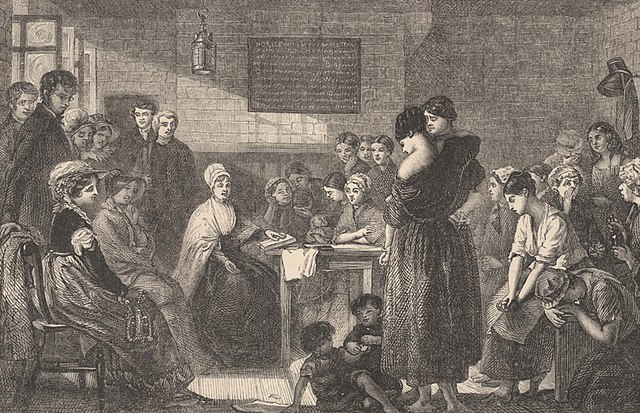
Elizabeth Fry reading to prisoners in Newgate Prison (London)

I believe there is something in the mind, or in the heart, that shows its approbation when we do right. I give myself this advice: Do not fear truth, let it be so contrary to inclination and feeling. Never give up the search after it: and let me take courage, and try from the bottom of my heart to do that which I believe truth dictates, if it leads me to be a Quaker or not.

Elizabeth Fry (1780-1845)

The Quaker testimony of integrity demands a consistency in words and actions with the truth. Indeed, the testimony of Truth (often with a capital T) is an alternate name that has been used historically. Importantly, the truth is not derived from an external authority, whether that be a person or a book. Rather, Quakers seek the truth as revealed within by the Spirit, or, as it is often phrased, by the Inner Light. It is not presumed that any individual has complete and infallible access to truth, but it is assumed that all who seek truth will be rewarded in some degree. That is the focus of Quaker worship, as individuals and as a gathered meeting. As the light begins to reveal truth to us, we are called to live according to that truth.

Integrity is living consistently with the truth. It demands both self-awareness and wholeness. It demands honesty, but goes beyond simply avoiding lies or dishonesty. All our words and actions should reflect the truth, even when they go against popular opinion or social convention. Many examples could pulled from history of Quakers acting in accordance with their deepest sense of the truth. The quote above comes from Elizabeth Fry, a Quaker who was called to work for reform of prisons in England.

More on the testimony of integrity is available on this page from the American Friends Service Committee:


https://www.afsc.org/testimonies/integrity

Peace

Anti-war protest on 5th anniversary of U.S. invasion of Iraq. March 19, 2008

Since the time of George Fox, Quakers have sought to avoid war or participation in wars.  The peace testimony remains one of the core elements of modern Quakerism, and is manifest in diverse activities of members of the Society of Friends in seeking peace and alternatives to violence.

Like all of the Quaker testimonies, it is a description of a commitment widely adopted by Friends, but not a creed or statement of belief required of members.  There is a story, based on oral traditon, which is frequently repeated among Friends regarding William Penn and George Fox.  Since the story does not appear in print until nearly two centuries after the supposed events, many doubt the historical veracity.  However, it does capture the spirit of more recent Quakerism.  The version below is from the earliest account by Samuel Janney (1852):

When William Penn was convinced of the principles of Friends, and became a frequent attendant at their meetings, he did not immediately relinquish his gay apparel; it is even said that he wore a sword, as was then customary among men of rank and fashion. Being one day in company with George Fox, he asked his advice concerning it, saying that he might, perhaps, appear singular among Friends, but his sword had once been the means of saving his life without injuring his antagonist, and moreover, that Christ had said, ‘He that hath no sword, let him sell his garment and buy one.’ George Fox answered, ‘I advise thee to wear it as long as thou canst.’ Not long after this they met again, when William had no sword, and George said to him, ‘William, where is thy sword?’ ‘Oh!’ said he, ‘I have taken thy advice; I wore it as long as I could.’

More information on the Quakers and peace, with links to many historical documents, is available from:

http://quaker.org/legacy/minnfm/peace/

Simplicity

‘Tis the gift to be simple, ’tis the gift to be free
    ‘Tis the gift to come down where we ought to be,
And when we find ourselves in the place just right,
    ‘Twill be in the valley of love and delight.
When true simplicity is gained,
    To bow and to bend we shan’t be ashamed,
To turn, turn will be our delight,
    Till by turning, turning we come ’round right

Traditional Shaker song (Joseph Brackett, 1848)

Simplicity is one of the traditional testimonies that Quakers uphold, although its expression has varied over time. Simplicity applies to material possessions, to our lifestyle, and our interior experience. Wendy Swallow of the Reno Friends Meeting has written a helpful reflection on simplicity in modern Quaker life. It is available here:

https://www.renofriends.org/personal-simplicity-a-complicated-idea/

Worship

Spiceland Meeting Room (Britain)

“I have never lost the enjoyment of sitting in silence at the beginning of meeting, knowing that everything can happen, knowing the joy of utmost surprise; feeling that nothing is preordained, nothing is set, all is open. The light can come from all sides. The joy of experiencing the Light in a completely different way than one has thought it would come is one of the greatest gifts that Friends’ meeting for worship has brought me.”

Ursula Franklin (1979)

Reflections on what to expect in an unprogrammed Quaker Meeting for Worship are given in this short video:

Prayer

O Spirit of that early day,
So pure and strong and true,
Be with us in the narrow way
Our faithful fathers knew.
Give strength the evil to forsake,
The cross of Truth to bear,
And love and reverent fear to make
Our daily lives a prayer!

—John Greenleaf Whittier (1807-1892)

One Friend’s reflections of prayer in Quaker practice can be found in this video:

Scripture

“Wait all on the Lord that you may be settled and stayed in the Lord, and to grow up in the Light that gave forth the Scriptures, that there may be no stumbling about the words, which came from the Light.  For no Creature can read the Scriptures to profit thereby, but who come to the light and Spirit that gave them forth.”

George Fox (Epistle 65, 1654)

An interesting discussion of how Quakers read the Bible is given in this short video: